
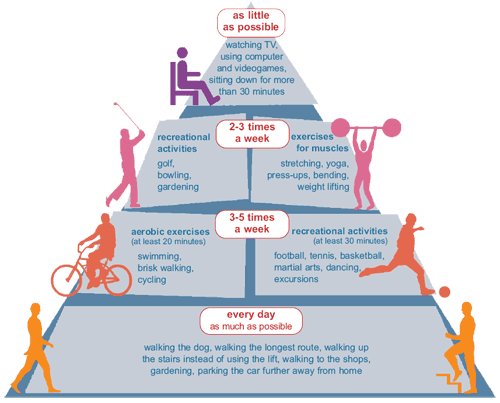
Government guidelines say adults should do at least two and a half hours of moderate activity each week – or one and a quarter hours of vigorous activity – or a combination of the two.
It can be confusing, but that alone probably doesn’t explain why only a third of adults are meeting the recommended amounts.
Much of the research on health recommendations comes from the American College of Sports Medicine, which has been studying levels of public fitness since the 1950s.
The World Health Organization also says physical inactivity is the fourth largest contributor to global deaths, and increases risk of some cancers, diabetes and heart disease.
The UK guidelines were drawn up in 1994, after several national surveys found low levels of activity were contributing to poor health.
But there’s an inherent tension in giving public health advice.
Broad advice can be sold in a single message, but nuance is harder to convey.
Stuart Biddle, professor of physical activity at Loughborough University helped to write the UK guidelines.
He says: “The debate was really around not so much whether the science showed physical activity was good for health, but to come up with sensible and evidence-based guidelines such as how much exercise, how often should we do it, can we break it up into smaller bouts, and it’s really that which was probably the most contentious.”
One of his colleagues, Jamie Timmons has been researching high intensity training, and whether health improvements can be found with just three minutes of exercise per week.
“During this year we’ve learned that while regular exercise will reduce your chance of developing or progressing to Type 2 diabetes, it was always expected that would also benefit your cardiovascular system,” he said.
“What we’ve now seen is a major US trial stopped early because essentially there was no benefit.”
He goes on to point out: “The guidelines are really based on one type of evidence – that’s epidemiology – and it’s not really the strongest level of science for cause and effect association.
“People who report that they do more physical activity seem to be better off.
“The question is if you take one individual and put them on a training programme, what benefits can they expect?”
Sir Liam Donaldson was chief medical officer for England from 1998-2010 and introduced the “five-a-day” fruit and vegetable message in 2003.
The following year he called for adults to exercise at least five times a week and suggested that household tasks could count as physical activity.
“At the time, I don’t think it was [oversimplified]. It may have come across as rather rigid.
“But by trying to be flexible and mentioning the housework and the gardening we ended up being lampooned a bit and that’s never good whenever you’re trying to get a serious message across.”
Has it worked?
“I don’t think there was significant progress, no. I do see public health as a long term business and so getting the evidence out – I do see that as a proper achievement.”
The same could be true in the US, where it’s claimed one in three Americans is obese.
Carol Garber, a vice-president of the American College of Sports Medicine, says guidelines could be better understood.
“Part of it is that they are complicated, the other is that we’ve not done a very good job of getting the information out to people in a way that it’s easy to understand and that they can take and implement it in their daily lives.”
The UK guidelines have now been updated to include specific advice for age-groups, strength training and avoiding sedentary behavior – the “silent killer” of sitting in a chair for several hours each day.
The Department of Health says: “Being active can help protect against heart disease, Type 2 diabetes and certain types of cancer which is why we have guidance on physical activity tailored to each age group.”
The message to be active is broadly understood, but the other crucial thing – to get up and move around as often as possible – is largely ignored.
“Twenty Plus” campaign: 20 seconds of intense activity when you can (running up stairs, cycling like crazy for short bursts on your bike), a minimum of 20 minutes of walking every day, and no more than 20 minutes of sitting at your computer or in front of TV without getting up and moving around.