
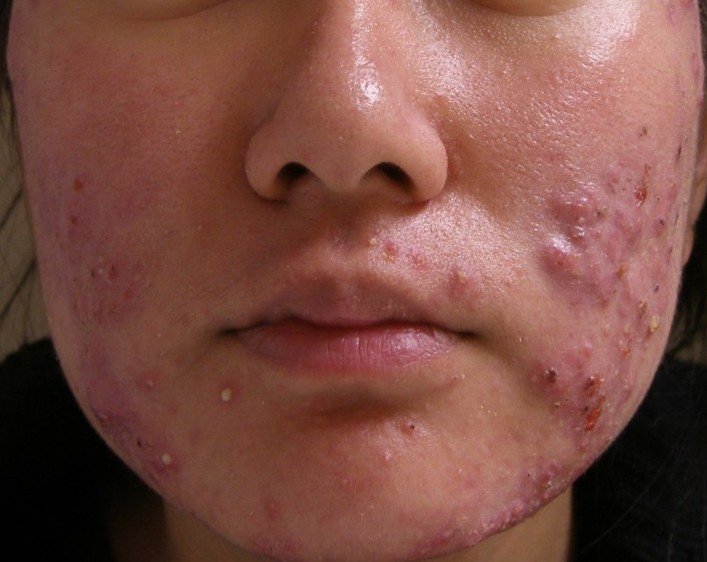
Scientists have discovered that a harmless virus that lives on our skin could be used as a treatment for acne.
The virus, called a phage, is naturally built to target and kill bacteria that cause acne – Propionibacterium acnes.
Experts at the University of California, Los Angeles (UCLA) and the University of Pittsburgh found 11 different versions of virus in this phage family that had this power.
They plan lab work to see if they can harness it as a therapy.
Scientists at other research institutes are also interested in phages as an acne treatment.
Lead scientist of the current work, Prof. Robert Modlin, said: “Acne affects millions of people, yet we have few treatments that are both safe and effective.
“Harnessing a virus that naturally preys on the bacteria that causes pimples could offer a promising new tool against the physical and emotional scars of severe acne.”
Acne is caused when hair follicles become blocked with an oily substance called sebum, which the body makes to stop the hair and skin from drying out.
Normally harmless bacteria, such as Propionibacterium acnes, that live on the skin can then contaminate and infect the plugged follicles.
Phages appear to help counteract this.
When the scientists sequenced the DNA coding of the phages, they discovered that as well as sharing most of their genetic material, the viruses all had some key features in common.
All carry a gene that makes a protein called endolysin – an enzyme thought to destroy bacteria by breaking down their cell walls.
And unlike antibiotics, which kill many types of bacteria including “good” ones that live in our gut, phages are programmed to target only specific bacteria.
Co-researcher Dr. Jenny Kim, director of the UCLA Clinic for Acne, Rosacea and Aesthetics, said: “Antibiotics such as tetracycline are so widely used that many acne strains have developed resistance, and drugs like Accutane, while effective, can produce risky side effects, limiting their use.”
Phages could potentially offer a tailored therapy with fewer side effects, the experts told the open access journal of the American Society for Microbiology, mBio.