
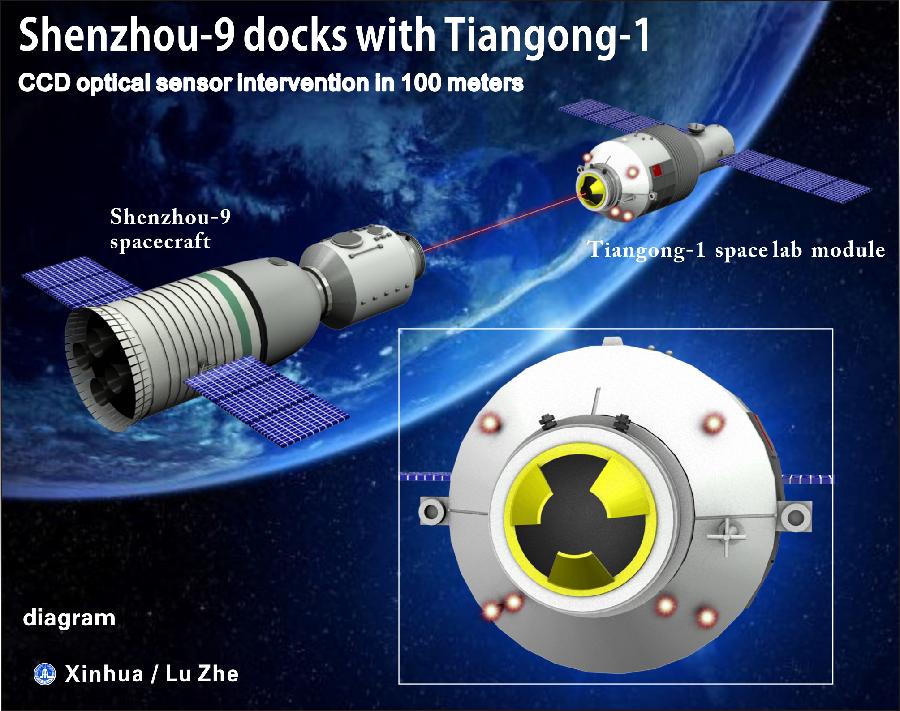
Shenzhou-9 capsule, with its crew of three, including the first Chinese woman astronaut, has docked with the Tiangong-1 space lab.
The coupling of the vehicles occurred just after 14:00 Beijing time (06:00 GMT) over China itself.
The latest Shenzhou mission was launched on Saturday, taking the nation’s first female astronaut, Liu Yang, into orbit.
Thirty-three-year old Liu Yang flies with Commander Jing Haipeng, 46, and fellow flight engineer, Liu Wang, 42.
It is China’s fourth manned mission and another opportunity to see how far the Asian nation has developed its space technology.
It follows on from last year’s unmanned Shenzhou-8 outing which completed successful rendezvous and docking manoeuvres at Tiangong.
That gave Beijing authorities the confidence to put astronauts on the current flight.
After Saturday’s lift-off from the Jiuquan spaceport, Shenzhou-9 worked through a series of engine burns to take it higher and closer to the orbiting space lab.
Monday’s docking was an automated procedure; computers – not the crew – were in charge of events.
A suite of radar, laser and optical sensors aligned Shenzhou with Tiangong. The capsule’s thrusters then drove it into the space lab’s docking ring.
The union happened at an altitude of about 340 km (210 miles). Liu Yang operated a handheld video camera to record the moment of docking.

It is understood that only two members of the crew will enter the lab at any one time. The third individual will stay in the Shenzhou craft in case of emergency.
During the flight, a range of scientific experiments are planned, including a number of medical tests geared towards understanding the effects of weightlessness on the human body.
At some point in the next few days, the astronauts will attempt a manual docking.
This would see the crew uncouple their vehicle from the lab, retreat to a defined distance and then command their ship to re-attach itself.
Liu Wang will take the lead in this activity.
“We’ve done over 1,500 simulations,” he said during the pre-launch press conference.
“We’ve mastered the techniques and skills. China has first class technologies and astronauts, and therefore I’m confident we will fulfill the manual rendezvous.”
China is already talking about a Shenzhou-10 mission to Tiangong sometime in the next year.
The lab is a prototype for the type of modules the nation hopes to join in orbit later this decade to form a permanently manned space station.
At about 60 tons in mass, this proposed station would be considerably smaller than the 400-tonne international platform operated by the US, Russia, Europe, Canada and Japan, but its mere presence in the sky would nonetheless represent a remarkable achievement.
Concept drawings describe a core module weighing some 20-22 tons, flanked by two slightly smaller laboratory vessels.
Officials say it would be supplied by freighters in exactly the same way that robotic cargo ships keep the International Space Station (ISS) today stocked with fuel, food, water, air, and spare parts.
The Shenzhou-9 crew is expected back on Earth before the end of the month.