
British researchers have developed a porous material that can preferentially soak up CO2 from the atmosphere.
NOTT-202 is a “metal-organic framework” that works like a sponge, absorbing a number of gases at high pressures.
But as the pressure is reduced, CO2 is retained as other gases are released.
The development, reported in Nature Materials, holds promise for carbon capture and storage, or even for removing CO2 from the exhaust gases of power plants and factories.
Metal-organic frameworks have been considered promising structures to trap gases for a number of years. They are so named because they comprise atoms of a metallic element at their core, surrounded by scaffolds of longer, carbon-containing chains.
These complex molecules can be made to join together in frameworks that leave gaps suitable for capturing gases.
However, until now, such frameworks have been good primarily at gathering any gas passing through them; those that were selective for CO2 have proven to have a low capacity for storing the gas.
“Increasing the selectivity for CO2 in the presence of gaseous mixtures represents a major challenge if these systems are to find practical applications under dynamic conditions,” the authors wrote.
The research started at the universities of Nottingham and Newcastle, where scientists discovered a chemical system that seemed to solve this problem of selectively storing a significant amount of CO2.
But to be sure of just what they had, they collaborated with a team at the Diamond Light Source in Oxfordshire and the Science and Technology Facilities Council’s Daresbury Laboratory to get a microscopic look at what they had created.
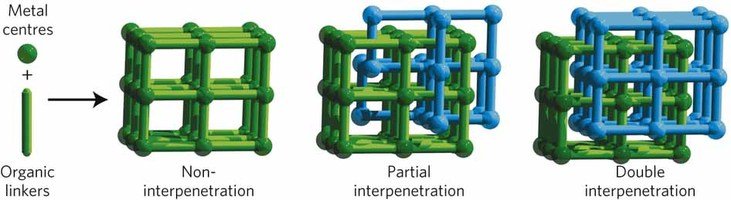
Using X-ray diffraction and detailed computer models, the researchers found that NOTT-202 is made up of two different frameworks that slot together incompletely, leaving “nanopore” gaps particularly suited to gathering up CO2.
This two-part structure, the researchers claim, is an entirely new class of porous material.
As such, research into just how similarly paired frameworks can be created may help researchers find a range of materials suited to soaking up specific gases.