
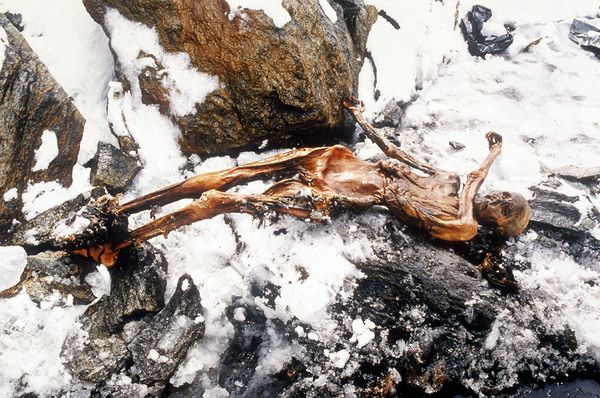
Researchers have found red blood cells around the wounds of Oetzi, the 5,300-year-old caveman found frozen in the Italian Alps in 1991.
Blood cells tend to degrade quickly, and earlier scans for blood within Oetzi’s body turned up nothing.
Now a study in the Journal of the Royal Society Interface shows that Oetzi’s remarkable preservation extends even to the blood he shed shortly before dying.
The find represents by far the oldest red blood cells ever observed.
It is just the latest chapter in what could be described as the world’s oldest murder mystery.
Since Oetzi was first found by hikers with an arrow buried in his back, experts have determined that he died from his wounds and what his last meal was.
There has been extensive debate as to whether he fell where he died or was buried there by others.
In February, Albert Zink and colleagues at the Eurac Institute for Mummies and the Iceman in Bolzano, Italy published Oetzi’s full genome.
An earlier study by the group, published in the Lancet, showed that a wound on Oetzi’s hand contained haemoglobin, a protein found in blood – but it had long been presumed that red blood cells’ delicate nature would have precluded their preservation.
Prof. Albert Zink and his colleagues collaborated with researchers at the Center for Smart Interfaces at the University of Darmstadt in Germany to apply what is known as atomic force microscopy to thin slices of tissue taken from an area surrounding the arrow wound.
The technique works using a tiny metal tip with a point just a few atoms across, dragged along the surface of a sample. The tip’s movement is tracked, and results in a 3-D map at extraordinary resolution.
The team found that the sample from Oetzi contained structures with a tell-tale “doughnut” shape, just as red blood cells have.
To ensure the structures were preserved cells and not contamination of some kind, they confirmed the find using a laser-based technique called Raman spectroscopy – those results also indicated the presence of haemoglobin and the clot-associated protein fibrin.
But the fibrin levels were much lower than would be expected in fresh wounds.
“Because fibrin is present in fresh wounds and then degrades, the theory that Oetzi died straight after he had been injured by the arrow, as had once been mooted, and not some days after, can no longer be upheld,” Prof. Albert Zink remarked.
The team also suggests that their methods may prove to be of use in modern-day forensics studies, in which the exact age of blood samples is difficult to determine.