
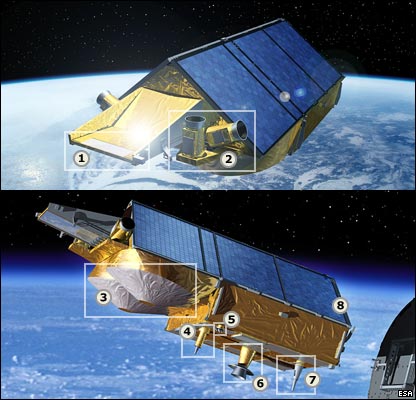
Cryosat, the European radar spacecraft launched in 2010 to monitor changes in the thickness and shape of polar ice, is now watching the ebb and flow of Arctic sea ice with high precision.
Scientists have spent the past two years getting to grips with its data.
And on Tuesday, they reported that Cryosat was now delivering an unprecedented view of the seasonal growth and retreat of sea ice spanning the entire Arctic basin.
The researchers also released a map showing the difference in height across the Greenland ice sheet.
“The message is that Cryosat is working extremely well. Its data are very reliable and the measurements we have match reality,” said Prof. Volker Liebig, the director of Earth Observation at the European Space Agency (ESA).
“We now have a very powerful tool to monitor the changes taking place at the poles,” he said.
The ESA director delivered an update on the mission at London’s Royal Society. The information was also being released here at the European Geosciences Union (EGU) meeting in Vienna, Austria.
Several satellites have already detailed the recent and rapid erosion of summer sea ice extent as the Arctic has warmed.
But Crysosat’s innovation has been to provide a means to get at a figure for ice volume – a far more significant number in terms of understanding the long-term viability of the ice.
To do this, the satellite carries one of the highest resolution synthetic aperture radars ever put in orbit.
The instrument sends down pulses of microwave energy which bounce off both the top of the ice and the water in the cracks, or leads, which separate the floes.
By measuring the difference in height between these two surfaces, scientists can, using a relatively simple calculation, work out the overall volume of the marine cover.
The Cryosat team, led from University College London, has spent the period since launch working through the satellite’s measurements, validating and calibrating them against a number of independent observations.
These include data from plane-borne instruments, from direct on-the-ice assessments, and even from scientific sea-floor moorings that profile the ice floes as they pass overhead.
“We can now say with good confidence that Cryosat’s maps of ice thickness are correct to within 10-20 cm,” said Dr. Seymour Laxon, from UCL’s Centre for Polar Observation and Modelling (CPOM).
Tuesday’s release shows a complete seasonal cycle, from October 2010, when the Arctic Ocean was beginning to freeze up following the summer melt, right through to March 2011, when the sea ice was approaching peak thickness. Cryosat found the volume (area multiplied by thickness) of sea ice in the central Arctic in March 2011 to have been 14,500 cubic kilometres.
This figure is very similar to that suggested by PIOMAS (Panarctic Ice Ocean Modeling and Assimilation System), an influential computer model that has been used to estimate Arctic sea ice volume, and which has been the basis for several predictions about when summer sea ice in the north might disappear completely.
In addition to the announcement on sea ice, the Cryosat team also published a digital elevation model (DEM) of Greenland.
The big island, too, has experienced some rapid changes of late and is losing tens of billions of tons of its ice cover to the ocean annually.
The DEM is a map of varying height, and the visualization on this page incorporates a year’s worth of data.
For Cryosat, it is another illustration of its capability. Radar satellites have traditionally struggled to discern the detail in the steep slopes and ridges that mark the edges of ice sheets, but the ESA spacecraft can recover far more information thanks to a special interferometric observing mode that uses two antennas.
“This is really the first demonstration of the interferometer in action,” said Prof. Andrew Shepherd from Leeds University.
“The DEM contains about 7.5 million data points, and we’re pretty confident this will be the best elevation model for Greenland, by some margin. Our next step is to compare it to previous data to see how Greenland has changed.”
Cryosat’s principal investigator, Prof. Duncan Wingham – formerly of UCL but now chief executive of the UK’s National Environment Research Council – summed up: “We have years of data to come, but I think it’s quite clear that we will provide synoptic, accurate, Arctic-wide thickness; and that we will be able to determine the accuracy of the predictions of when the Arctic will be ice-free in Summer.
“And I think it’s also clear we can now sustain coverage of [ice sheets on Antarctica and Greenland] right down to the coast.”
The Cryosat update was timed to coincide with this week’s 50th anniversary of UK activity in orbit.
April 1962 was the month Britain became a space-faring nation with the launch of its first satellite, Ariel-1.