
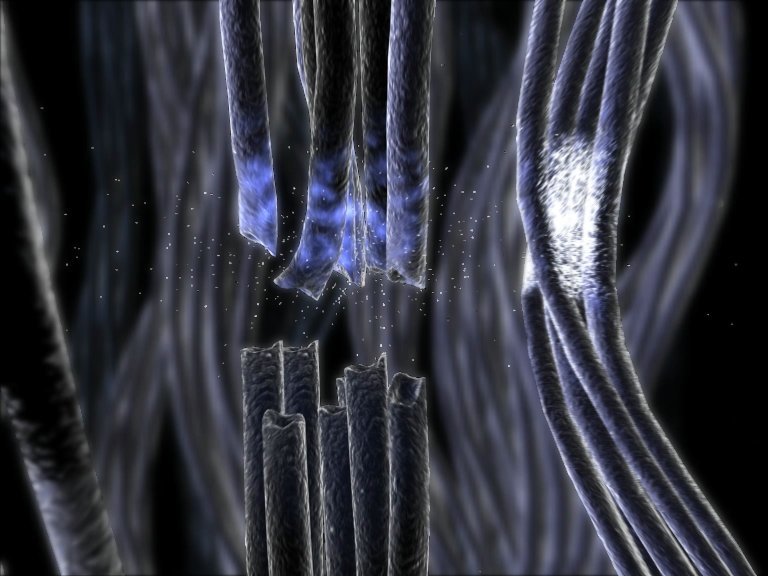
An international group of researchers say a “miniature honeycomb” – or scaffold – could one day be used to encourage damaged nerves to grow and recover.
The scaffold can channel clusters of nerves through its honeycomb of holes, eventually healing a severed nerve.
The findings of their study on mouse nerves are published in the journal Biofabrication.
Academics hope to one day treat spinal cord injuries with the scaffold.
When nerves are severed, such as in car accidents, it can result in a loss of feeling and movement.
Repairing this damage can be a challenge – but nerves outside of the brain and spinal cord can repair themselves, if only over short distances.
One technique to improve this repair is to use tubes. Either end of the severed nerve is placed in a tube and the two ends of the nerve should grow and join in the middle.
Researchers at the University of Sheffield and Laser Zentrum Hannover, Germany, investigated using a honeycomb structure.
Dr. Frederik Claeyssens, from the department of materials science and engineering at Sheffield, said: “That is much more like the structure of the nerve itself.
“The nerve has small regions of ‘cable’ that go through from one end to the other end, you have a whole bunch of little cables inside a larger cable, that’s what we tried to reproduce with this type of scaffold.”
The honeycomb is made from photopolymerizable polylactic acid, which biodegrades once the nerve has repaired.
The researchers showed nerve cells could grow on the scaffold and are now testing it in mice to see if it can fully repair the damage.
Dr. Frederik Claeyssens said: “This technology could make a huge difference to patients suffering severe nerve damage.”
Scaffold technology is used in a range of “regenerative medicines”. Building a scaffold and then coating it with human cells has, for example, been used to give patients new windpipes and bladders.