
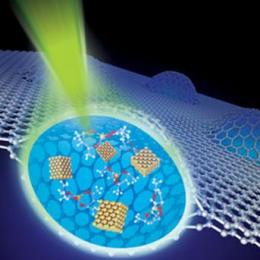
A new report in Science journal gives details on how carbon-based material graphene can help scientists study liquids more clearly with high-power microscopes.
Graphene can form a clear “window” to see liquids at higher resolution than was previously possible using transmission electron microscopes.
Liquids had been difficult to view at the same resolution as solids because these microscopes require the liquids to be encapsulated by some material.
Traditionally, silicon nitride or silicon oxide capsules, or liquid cells, have been used. But these are generally too thick to see through clearly.
Now, Jong Min Yuk at the University of California, Berkeley, and colleagues have shown that pockets created by sheets of graphene can be used to study liquids at clear, atomic, resolution using transmission electron microscopes (TEMs).

The researchers used their new graphene-based liquid cell to study the formation of platinum nanocrystals in solution.
With this technique, the team of scientists was able to observe new and unexpected stages of nanocrystal growth as it happened.
They noted how the crystals selectively coalesced and modified their shape.
Graphene consists of a flat layer of carbon atoms tightly packed into a two-dimensional honeycomb arrangement.
Because it is so thin, it is also practically transparent. The unusual electronic, mechanical and chemical properties of graphene at the molecular scale promise numerous applications.
Its discoverers, Andre Geim and Konstantin Novoselov from Manchester University, were awarded the Nobel Prize for Physics in 2010.
The technique described by Jong Min Yuk and colleagues might enable scientists to study other physical, chemical, and biological phenomena that take place in liquids on the nanometre scale.
“Their approach opens new domains of research in the physics and chemistry in the fluid phase in general,” said Christian Colliex, from the Universite Paris Sud in France, who was not involved with the research.
In another paper published in this week’s Science magazine, researchers from the US and Spain report that the stress of pressing the tip of an atomic force microscope into a thin film of material can switch the direction of the film’s electric charge.
This phenomenon, called “flexoelectricity”, could be harnessed to improve memory in electronic devices.
It could achieve this by allowing digital bits of information to be written mechanically but read electrically – which would use less power.
The process has been likened to a nanoscale typewriter – mechanically “writing” changes in the direction of electric charge.