

One of the challenges of the U.S. government during nuclear weapons testing in the early 50’s was to design a camera capable of capturing a nuclear device mid-explosion.
The result, unearthed this week by blog Damn Interesting, was the “Rapatronic” camera – an ultra-high-speed camera that sat seven miles from the blast site and captured images at high speed – including the image of an 100-ft ball of fire, one ten-millionth of a second after detonation.
The images were taken during the Tumbler-Snapper nuclear tests in 1952.
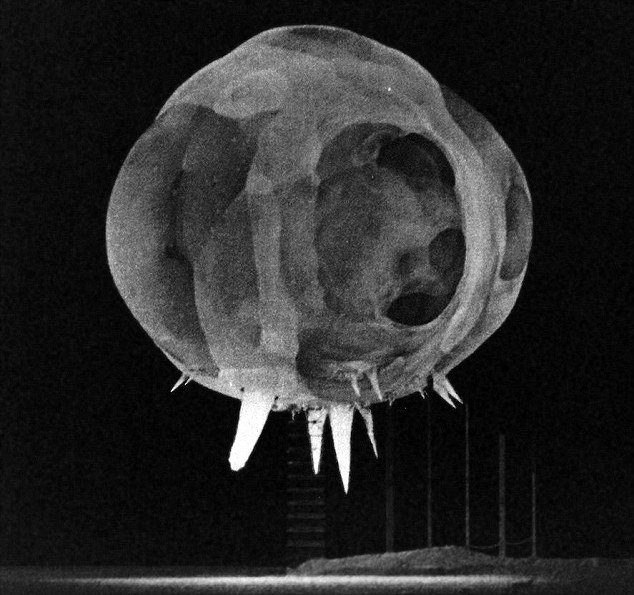
Damn Interesting wrote: “These single-use cameras were able to snap a photo one ten-millionth of a second after detonation from about seven miles away, with an exposure time of as little as ten nanoseconds.”
“At that instant, a typical fireball had already reached about 100 feet in diameter, with temperatures three times hotter than the surface of the sun.”
No technology at the time was available to wind the cameras on fast enough to take a second photo – so the military typically used arrays of ten cameras aimed at the same bomb.
No shutter could move fast enough, either, so the camera specialist who designed the Rapatronic camera used an array of polarized lenses combined with an electrical element to “shut” the camera shutter in one ten-millionth of a second.
The designer, Harold Eugene Edgerton, a MIT photography specialist, is also credited with popularizing strobe lighting.