
On August 27, AFP announced that Goethe had been voted the greatest
German of all time in a poll of 2,000 people.
The survey was conducted by the Forsa institute for the daily Bild newspaper.
Konrad Adenauer, West Germany’s first chancellor after World War II (1949-1963) was the second choice of the readers, while Albert Einstein was the third.
There were only two living personalities who received votes: Helmut Kohl, longest-serving leader (1982-1998), in fifth place and Helmut Schmidt, Social Democrat leader (1974-1982), in seventh.

August 28 marks Goethe‘s 262th birthday anniversary.
Johann Wolfgang von Goethe (1749-1832) is best-known for his epistolary novel The Sorrows of Young Werther and his long poem Faust, but he was a polymath, or Homo Universalis (universal man), as he tried and succeeded to cover a lot of fields of culture (philosophy, literature, science).
The Sorrows of Young Werther (1774) was somehow autobiographic novel and belongs to the Sturm und Drang (storm and urge) period in German literature. The novel started Werther-Fieber (Werther Fever) with young men adopting Werther’s dressing style and led to some copycat suicides.
Goethe in someway regretted he had written this novel because he had exposed his youthful love. The Sorrows of Young Werther became almost the only work for which Goethe was known.
Goethe came up with hundreds ideas that later became widespread. He created poetry, essays, criticism, a theory of colours and early work on evolution and linguistics. There is even a mineral goethite (iron oxide), named after him, because of his studies of mineralogy.
His philosophic writings stimulated philosophers, such as Hegel, Schopenhauer, Nietzsche, Jung. Goethe’s poetry inspired Austrian and German composer like Mozart, Mahler, Beethoven. He also influenced French drama and opera.
Fantasia (1940 Disney film) was based on the story from Goethe’s poem Der Zauberlehrling (1797), which is translated The Sorcerer’s Apprentice. Mickey Mouse plays the apprentice. The movie was so popular that Fantasia 2000, a 1999 sequel, followed.
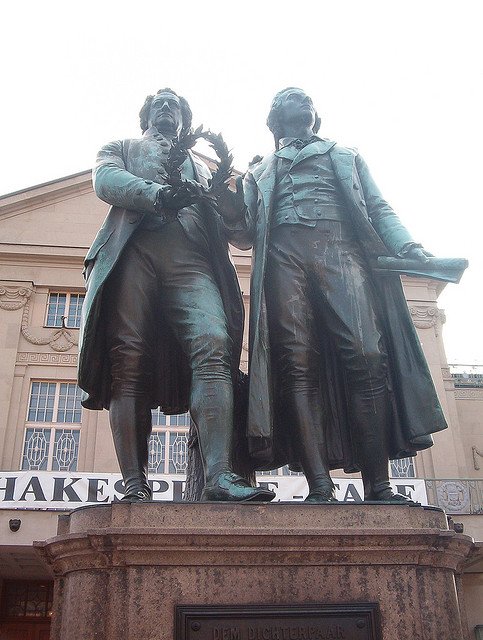
Goethe and Johann Christoph Friedrich von Schiller were leading personalities of Weimar Classicism.